In an ideal world, every nation seeks independence and aims to meet its own needs without relying on others. However, each country has distinct differences in demographics, geography, resources, and technology. This variance allows some nations to produce goods more cheaply and efficiently than others. In economic terms, it’s called comparative advantage and competitive advantage. As a result, countries must engage in international trade.
In international trade, each country prioritizes its own interests first. The influence of technology and resource ownership becomes a significant source of bargaining power. Therefore, there must be rules that govern the parties to prevent unfairness and discriminatory trade practices.
Indonesia – European Union Trade Relations
Indonesia actively opens cooperation with bilateral and multilateral trade. One of the trade relations is with the European Union.
The EU ranks as Indonesia’s fifth-largest trading partner, representing 6.4% of the nation’s total trade. Indonesia is the EU’s 33rd-largest trading partner and the EU’s fifth-largest trading partner within ASEAN in 2024. The total value of bilateral trade in goods between Indonesia and the EU reached €27.3 billion in 2024, with EU exports amounting to €9.7 billion and imports from the EU totaling €17.5 billion.

In 2023, the total bilateral trade in services between the EU and Indonesia reached €8.8 billion, with the EU’s exports totaling €5.7 billion and imports at €3.1 billion.

In 2023, the stock of foreign direct investment (FDI) from the EU in Indonesia reached €25.1 billion, whereas Indonesia’s FDI stock in the EU was €1.1 billion.

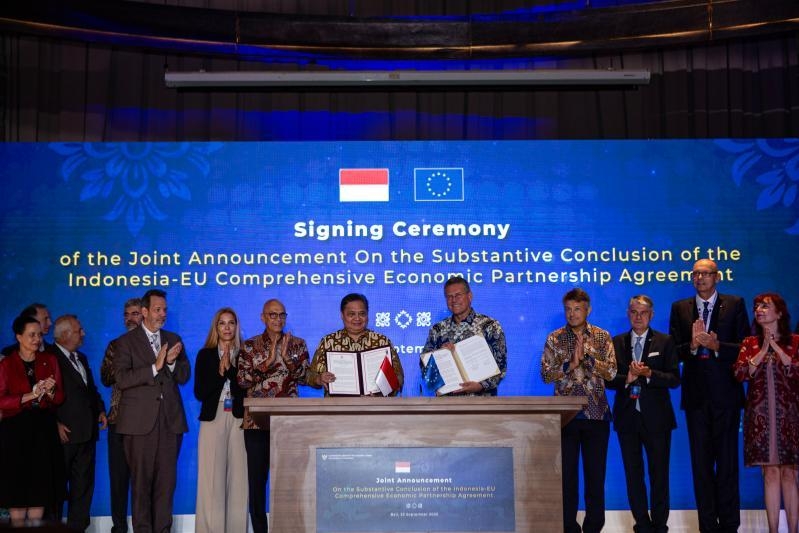
Currently, on September 24th 2025, Indonesia and the European Union officially concluded the Indonesia–European Union Comprehensive Economic Partnership Agreement (IEU CEPA) and Investment Protection Agreement. This agreement aims to liberalise and facilitate trade and investment, as well as to promote a closer economic relationship between the Parties and reaffirm their commitment to create a better climate for the development of investment between them.
IEU CEPA broadly governs economic and trade cooperation between the EU and Indonesia. It covers the liberalization of trade in goods through tariff elimination and rules of origin, as well as customs and trade facilitation measures and trade remedies, such as anti-dumping. The agreement also regulates trade in services and investment, including market access, movement of natural persons, digital trade, and capital movements. In addition, it addresses regulatory areas such as technical standards, sanitary and phytosanitary measures, government procurement, intellectual property rights, competition policy, and the role of state-owned enterprises, aiming to create a transparent and fair trading system.
Meanwhile, the EU–Indonesia Investment Protection Agreement (IPA) focuses specifically on protecting investments between the two parties. It establishes key principles such as fair and equitable treatment and protection against expropriation, while also providing mechanisms for dispute settlement, including investor–state and state-to-state disputes.
Together, these agreements complement each other by strengthening bilateral economic relations, ensuring legal certainty for businesses and investors, and promoting sustainable economic development between the EU and Indonesia.
Indonesia Downstreaming Policy
Since 2014, under the 7th President of Indonesia, Jokowi, Indonesia has prioritized industrialization based on natural resources, mainly energy and minerals, as a structural transformation. This strategy stems from the assumption that Indonesia’s comparative advantage lies in the richness of its natural resources, but it only needs to maximize this advantage by developing domestic downstream industries (Rodrik, 2004; Auty, 2001).
In January 2014, Indonesia began banning the export of certain mineral ores, including nickel ore. This policy triggers significant changes in the industry. Mining companies are incentivized to build domestic processing facilities; as a result, investment in smelters has increased on a large scale, mainly in Sulawesi and North Maluku (OECD, 2019; World Bank, 2020).
As a structure, the ban on nickel ore exports and expanded processing capacity have significantly increased the export value of iron and steel in the last decade. It shows the shift from the export orientation toward raw commodities to higher-value-added products. However, from a structural transformation perspective, the next challenge is to ensure that this capacity expansion is followed by strengthening domestic technology, product diversification, and increasing industrial complexity. (Hausmann, Hwang, & Rodrik, 2007; Rodrik, 2016).
The policies of downstreaming industries continue under the current President administration, Prabowo Subianto. On April 29th, 2026, he inaugurated the groundbreaking of 13 downstream projects across several locations in Indonesia, amounting to IDR 116 trillion, or USD 6.82 billion (at an IDR 17000/USD exchange rate).
These national strategic initiatives encompass energy, downstream industrial processes, and agro-processing, aimed at bolstering Indonesia’s economic resilience and value generation. In the energy domain, PT Pertamina (Persero) is increasing gasoline refinery capacity in Dumai and Cilacap (62 MBSD, scheduled for completion by 2030) to cut fuel imports by almost 10%, while also establishing fuel storage facilities in eastern Indonesia and a coal-to-DME plant in Tanjung Enim to replace up to 80% of LPG imports and strengthen energy security. In the industrial realm, PT Krakatau Steel (Persero) Tbk. and its partners are expanding production of nickel-based stainless steel in Morowali and carbon steel in Cilegon, as well as asphalt processing and copper-gold downstream projects, to elevate domestic manufacturing capabilities and infrastructure competitiveness. At the same time, agro-industrial efforts led by PT Perkebunan Nusantara III (Persero) focus on processing palm oil, nutmeg, and coconut to boost export value, farmers’ earnings, and regional economic growth. Together, these initiatives strive to reduce reliance on imports, promote industrialization, create jobs, and foster inclusive and sustainable economic development throughout Indonesia.
Indonesia – EU Disputes under the WTO
In the last five years, at least Indonesia has had some cases with the EU under the WTO, including the following:
- DS618 European Union — Countervailing Duties on Imports of Biodiesel from Indonesia (Panel report under appeal on 26 September 2025 )
- DS592 Indonesia — Measures Relating to Raw Materials (Panel report under appeal on 8 December 2022 )
- DS593 European Union — Certain Measures Concerning Palm Oil and Oil Palm Crop-Based Biofuels (Objection to the request for authorization to retaliate (Arbitration under Article 22.6 of the DSU requested) on 19 March 2026)
It’s interesting because those three disputes are related to the downstreaming. Moreover, Valdis Dombrovskis, Executive Vice-President and Commissioner for Trade, European Commission, in the press release on November 30, 2022, stated:
“This is a clear verdict that Indonesia’s export restrictions are not compatible with WTO rules. I expect Indonesia to comply with their WTO obligations and remove these measures immediately. The EU supports the rights of all countries to economic development, but this does not give a licence to set aside WTO rules.”
Challenges for Indonesia’s Trade Policy
Indonesia has been a member of the WTO since January 1st, 1995, through ratified Law Number 7 of 1994, which aims to realize national development. As a consequence, Indonesia has to comply with the WTO Rules, which rule that international trade must be based on Non-Discrimination, Free Trade Through Negotiations, Predictability and Transparency, Fair Competition, Development, and Flexibility.
It sounds unfair to people to hear that trade, which involves resources clearly owned by nations, must be controlled. But if we look at it from a broader perspective, it would be unfair to the other nations that lack access to those resources. So, which is the true fairness?
Indeed, nowadays we face anomalies as international trade shifts toward a trade war. For instance, a major country such as the US imposed high tariffs on China and other nations. The rules of the game seem to be set aside, hidden behind the national interest. But we have to believe that, instead of improving the economy, it would worsen the economic situation, back to the interdependence between nations.
Developed countries rely on materials from developing countries, and developing countries, such as Indonesia, have the right to develop and grow their economies to become developed countries. But the market will find equilibrium; no nation will become only a producer or consumer; it will always be both buyer and seller, and it will be a competition.
If Indonesia wants to succeed in the downstreaming projects, it should support them with policies aligned with the trading principles. No shortcut to being an established system.
IEU CEPA and IPA will serve as the gateway for Indonesia and the European Union to a more strategic and comprehensive economic relationship. It’s a specialized law governing trade that will bind both parties. It will also bolster the implementation of international trade principles and prevent trade disputes.
References:
European Commission Official Website, 2026.
Hanan Nugroho and Nur Laila Widyastuti, Hilirisasi Pertambangan dan Masa Depan Industrialisasi Indonesia: Pembelajaran Historis dan Rekomendasi Strategis, Bappenas Working Paper Volume IX No. 2, 2026.

Leave a Reply